-
I was born in India to a French-Italian mother and a Chinese-American father—a photojournalist who documented the world’s upheavals, from the war in Afghanistan, the massacre in Tiananmen Square, to the fall of the Soviet Union. My childhood unfolded across cultures, languages, and revolutions.
My parents fleeing wars and revolutions growing up imparted in me a deep understanding of resilience, change, adaptability, and a global perspective.
Martial arts, dance, theatre, and holistic care practice teach you to adapt to given circumstances; they provide tools for examining, unpacking, and expressing humanity beyond words. Being raised in motion and adapting to a chaotic environment was part of my heritage and education. Media was a way of staying connected to the happenings of the world, places where my family had scattered their heart like bread crumbs. I studied and put into practice what I knew to be essential. Using words to communicate one’s emotions, let alone understanding the effects of trauma, was not an option for my parents. My father took pictures to inform the world and my mother practiced yoga. Both cultivated a love for the arts especially cinema and music. The schools I attended, largely disembodied, did not provide the tools and narrative medicine to unpack the embodied experience of students; anything that had to do with embodied cognition and identity construction had been stripped away and replaced with the school curriculum, teaching general subjects.
I grew up between New Delhi, Seoul, Moscow, Hong Kong, Paris, Beijing and New York, surrounded by spaces, people, stories, cultures and physical traditions that became parts of me—from my grandmother’s athletic practice and my mother’s qigong and yoga dedication to my father on the run carrying heavy cameras documenting wars, revolutions and transforming empires. My family was busy putting their body to work however they could; practicing a self learned form of resilience and adaptation, learning languages and skills to thrive in a transforming world.
These influences laid the foundation for what would become for me a lifelong inquiry into movement arts as a health science, cultural forms, embodied cognition, kinesthetic education and more importantly a personal and community development vehicle.
Those practices, pedagogues, artists, and researchers I emulated helped shape my identity and appreciation of the world, but more than that, I realized they formed an immaterial global heritage, a human anthropology of cultural practices and lineages that anchored my existence, helping me find my way back to self through major challenges. This experiential wisdom is the embodied bedrock for all cultures. It is the passion that steers my body; more than that, now I realize it is the path that has allowed me to assimilate a very chaotic and traumatic upbringing through collapsing worlds, a third culture kid on a roadless travel, raised by war-torn immigrant parents of immensely different cultures. We were too busy running to talk about it. I believe my father thought looking at pictures was enough for me to understand, learn, and figure it out along the way. As a kid, my bedroom bore portraits of Chairman Mao, Stalin, Lenin… one week I didn’t go to school, tanks were in the streets. My father was in the Kremlin photographing Gorbatchev signing the dissolution of the Soviet Union. From one day to the next, without warning, I was parachuted to the tropical island of Hong Kong, the homeland of my father, a British colony.
We attended brunches at the Foreign Correspondents Club in Hong Kong yet I was raised like a little soviet, mysteriously from India and Korea.
I was told I was French and Chinese, and had not lived in either of those countries yet. In the last year, the financial crisis of 1997 hit, we were living in the former PRC barracks, the Chinese army moved into our homes as Prince Charles wished Hong Kong farewell, my parents separated, my father went to China, and my mother to France. I was ten years old. This is how I grew up, and nothing before or after could be explained by the schools I attended; I was living modern history day by day, and had nothing but my own body to train the skills, and develop the tools to assimilate a fast-changing world. I believe in the age of globalization, social media, careers shifting at the speed of tech start-ups, nomadic digital parents and artificial intelligence more children and adults will have to grapple with the challenges of third culture kids, war refugees, climate immigrants, everyone is realizing that the toolbox is limited and it is time to turn to embodied wisdom. Picking up where my parents left off, I seek to combine movement, poetry, music and the body to tell stories. I hope we can continue to steer media towards the wisdom carried by our bodies.
-
Today, I offer Portraits in Motion —A series of cinematic portraits, exploring bodies and untold stories accross New York City.
Limited slots available for somatics & movement coaching, specialized workshops for actors, retreats and events. I am also filming digital programs—designed for artists, athletes, and seekers navigating injury/developmental challenges, transition, or creative thresholds.
My work invites each body to become more than functional—to become articulate, intuitive, and free.
-
Benjamin’s work supports:
Humans willing to share their story.
Artists, athletes, and performers seeking physical attunement, skill development and creative inspiration.
Individuals with neurological or physical challenges (Parkinson’s, cerebral palsy, chronic pain, stroke recovery, spinal injuries), suffering from emotional and physical trauma.
-
Ben Hemmer Liu is a director, actor and somatic movement therapist whose work bridges physical recovery, adaptive conditioning and embodied performance. His teaching synthesizes years of training across martial arts, theatre, somatic therapy and holistic health—guiding individuals toward strength, awareness, and expressive freedom.
Raised between cultures and disciplines, Ben began training in martial arts at a young age, drawn to how physical practice—through breath, rhythm, and form—could shape the nervous system and cultivate resilience. This early training became a lifelong inquiry into how the body learns, remembers, and transforms through skill development and embodied learning.
He studied the Feldenkrais Method, learning to retrain movement through neuroplastic pathways and subtle sensory awareness obtaining certification as a practitioner. He trained in Russian Systema —a modern military combative approach to physical & psychological conditioning becoming a certified instructor. A lifetime of teaching how to weaponize and heal the human body with softness, breath, and adaptability under pressure drawing from all the styles he practiced, became the core of his martial approach. He explored Somatic Parts Work to support trauma recovery through embodiment obtaining certification. And through the Lecoq school of physical theatre, he discovered rhythm, mask, and gesture as tools for both artistry and integration. Whilst continuing to follow teachers and devoted pedagogical training in the above practices Benjamin also became a National Academy of Sports Medicine Certified Personal Trainer with multiple continuous education specialties and is also a certified yoga instructor with the Yoga Alliance.
Drawing from a lifetime of practice, research and teaching experience he helps artists, athletes, and seekers refine coordination, reclaim agency, and rediscover the body as a source of power, play, and poetic intelligence.
These threads converged into AOM: Anthropology of Movement—a cross-disciplinary pedagogy and educational effort to document the roots, lineages, stories, practices and embodied forms contained in what is widely known as movement and somatic practice. AOM honors lineage, embraces modern research, and strives to address the educational needs of the 21st-century. AOM invites each body to become more than functional—to become articulate, intuitive, and free. It is this pursuit of wisdom that shaped Ben’s appreciation of embodied cognition, kinesthetic intelligence, experiential learning, creative play, and martial conditioning.
-
AOM is dedicated to fostering creativity, discovery, and a deeper understanding of what it means to be alive as a developing human being in the age of globalization and artificial intelligence.
This work is shaped by 3 founding pillars and a constellation of teachers and lineages
Moshe Feldenkrais – Awareness through movement
Michael Ryabko & Vladimir Vasiliev – Breath & adaptability under pressure
Jacques Lecoq – Gesture, rhythm, physical storytelling
“Special gratitude to family, friends, the masters, teachers, researchers, performers who have planted seeds, passed on the torch and given me legs to find my way through this world whether it be through formal education, personal research, or the wisdom passed down through generations, these figures represent a vast universe of knowledge. I apologize for any I may have overlooked.
Jean Pierre Barral, Andrew Taylor Still, William Sutherland, Ida Rolf, Thomas Myers, Tirumalai Krishnamacharya, B.K.S. Iyengar, T.K.V. Desikachar, Joseph Hubertus Pilates, Eugen Sandow, Max Sick, Alexander Zass, Charles Atlas, Jack LaLanne, Pavel Tatsouline, Francois Delsarte, Jean Louis Barrault, Jacques Lecoq, George Hebert, Marie Overlie, Richard Crawford, Norman Tailor, Amy Russel, Suzanne Bing, Etienne Decroux, Antonin Artaud, Marcel Marceau, Jerzy Marian Grotowski, Augusto Boal, Viola Spolin, Anton Chekhov, Konstantin Stanislavski, Vsevolod Meyerhold, Lee Strasberg, Sanford Meisner, Molière, Shakespeare, Rudolph Laban, Pina Bausch, Martha Graham, Ohad Naharin, Steve Paxton, Gabrielle Roth, Keith Johnstone, Charlie Chaplin, Guy Laliberté, Anne Bogart, Bruce Lee, Yip Man, Morihei Ueshiba, Kano Jigoro, Zhang Sanfeng, Master Zhang, Wang Zhi Peng, Wong Shun-leung, Nino Bernardo, Hélio Gracie, Antonio Damasio, Immordino Yang, Daniel Wolpert, George Lakoff, Andrew Huberman, and many others have laid the foundation for our culture and education of embodiment, storytelling, and the cultivation of mind-body-spirit awareness.
Through Anthropology of Movement, I strive to honor their legacies and to continue building a rich, inclusive, and holistic approach to education and growth in movement.”
-
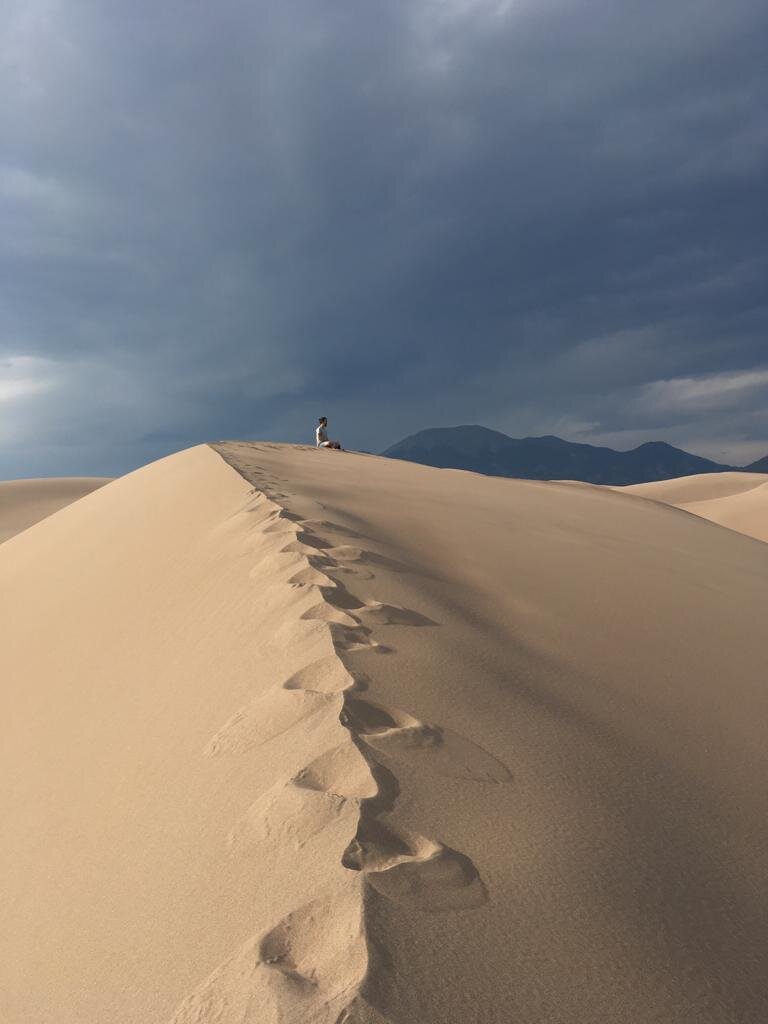
“I believe embodied movement is a language of gesture—one that expresses who we are before words can.
More than just muscles and mechanics, the body carries memory, identity, tension, and truth. Healing is not simply individual—it is relational, communal, and creative. There is a system, pedagogy and method, that drives this process. The body seeks to grow, I view media as a manifestation of this desire to grow the idea that is the body, like a tree grows towards the sun so our body seeks to connect to community. This dance between the inner and outer world, between the parts we hold, between our first breath and our very last is what we call life.
My mission is to reconnect people to their bodies—not just for function, but for freedom, growth and creative expression. Through AOM and embodied coaching, I help others reclaim the body as a site of clarity, creativity, and resilience.”